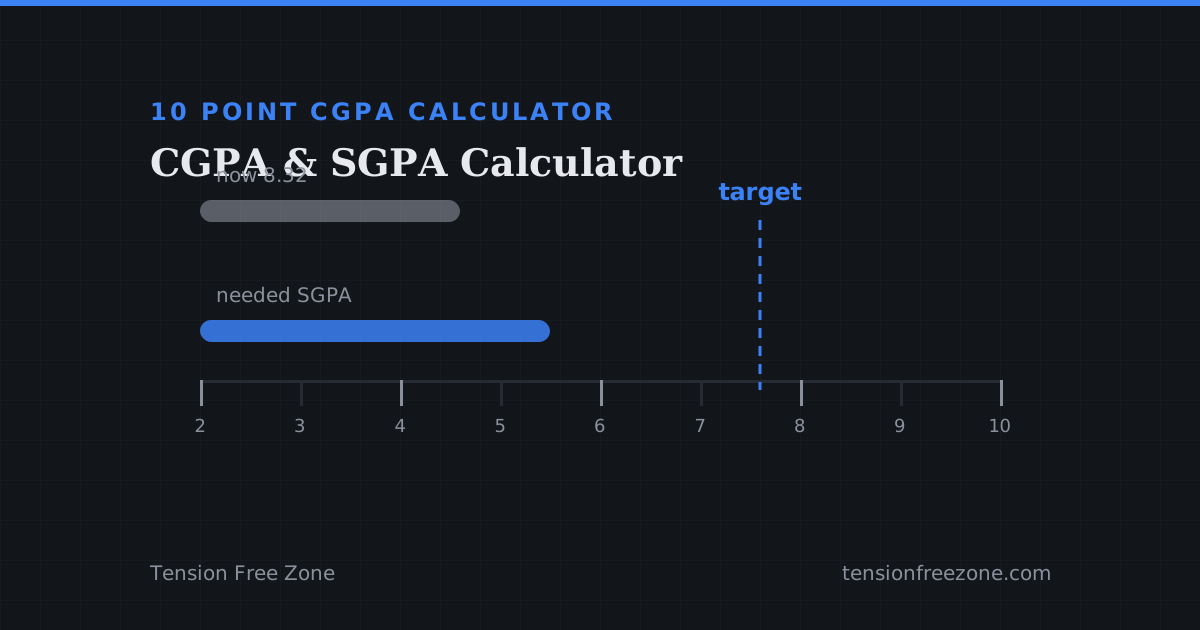
The 0.18 Gap: The Precise Math I Needed to Protect My Honours Degree
How the what-if planner on a 10 point CGPA calculator works out the SGPA you need for a target, and why the credits behind each grade decide the answer.
Calculate semester GPA, cumulative CGPA, and plan what grades you need with the what-if target planner. 4.0 and 10-point scales.
SGPA is one semester: the average of your grade points, weighted by credits. CGPA is the average across every semester you have completed, weighted by the credits you took in each. A 4-credit course counts twice as much as a 2-credit one, which is why a bad grade in a lab can matter less than the same grade in a core course.
The calculator adds your courses per semester, converts to SGPA, then carries the totals into a CGPA. It also has a what-if mode: given the credits you have left and the CGPA you want, it says which grades would get you there, or whether the target is already out of reach.
Four courses in semester one: 4 credits at 9 points, 3 credits at 8, 3 credits at 7 and 2 credits at 10. The credit-weighted total is (4x9) + (3x8) + (3x7) + (2x10) = 36 + 24 + 21 + 20 = 101 over 12 credits, so SGPA is 8.42.
Semester two has three courses: 4 credits at 9, 4 credits at 8, 2 credits at 9. That is 36 + 32 + 18 = 86 over 10 credits, an SGPA of 8.6. The CGPA is not (8.42 + 8.6) / 2 = 8.51; it is (101 + 86) / (12 + 10) = 187 / 22 = 8.5, because semester two carried fewer credits. The difference is small here and larger when the semesters differ in load, which is exactly when people get it wrong.
Averaging SGPAs instead of credit-weighting every course. The two agree only when every semester has the same credit load.
Applying a fixed multiplier to convert CGPA to percentage. Universities differ, and a 9.5 multiplier is one university system, not a standard.
Excluding a backlog or a supplementary exam result. Most transcripts include it once it is passed, and the CGPA that matters is the one printed there.
Planning a target without checking the credit count left. Ten credits cannot lift a CGPA as much as a full final year can, and the planner says so before you rely on it.
Nowhere. Grades are calculated in this tab and saved in this browser, not on a server, so a failing semester is not a record anywhere but on your own device.
How the what-if planner on a 10 point CGPA calculator works out the SGPA you need for a target, and why the credits behind each grade decide the answer.
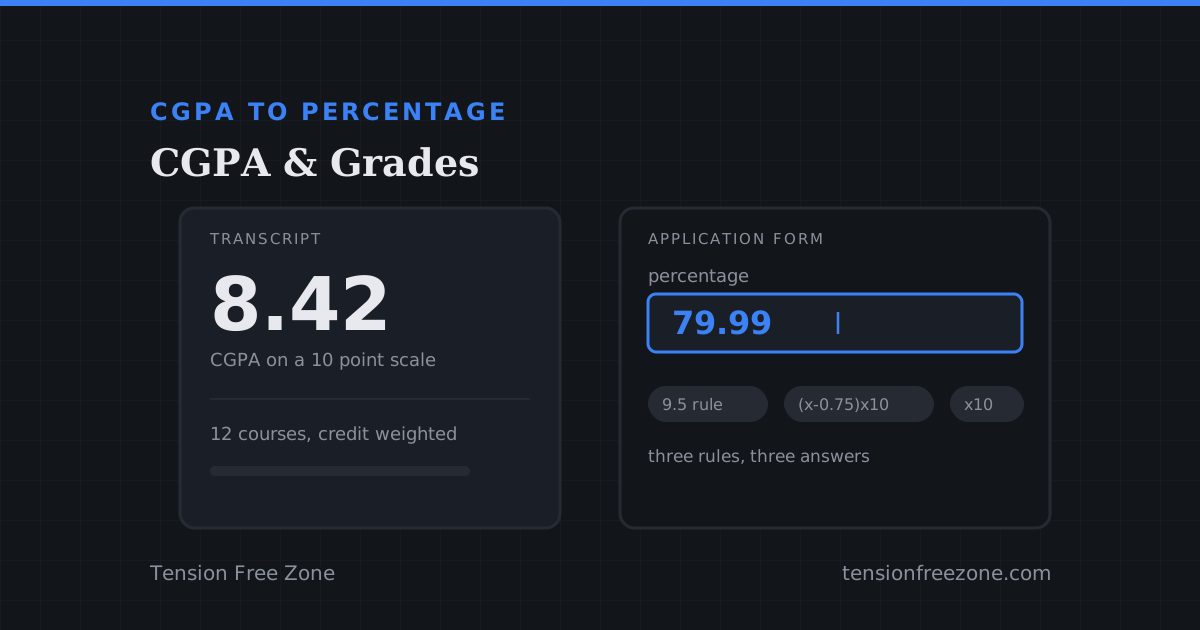
The 9.5 multiplier, when it is wrong, and how to convert CGPA to percentage the way your own university defines it, with worked examples.
Semester GPA is credit-weighted from each course’s grade points; CGPA is the credit-weighted average across all semesters you enter. Both 4.0 and 10-point scales are supported.
The What-If planner shows exactly the GPA you need next semester, or across several semesters, to reach a target CGPA.
No. Course rows live in your browser’s localStorage only; there is no account and no upload.
CGPA = total credit points earned across all semesters / total credits taken. Each course contributes its grade point multiplied by its credits. Averaging the SGPAs gives a different, wrong answer unless the semesters carry equal credits.
Use the rule your university publishes. A common one is CGPA x 9.5, which suits a 10-point scale where 10 equals about 95 percent; many institutions use CGPA x 10 instead. There is no universal conversion, and a form that asks for a percentage usually expects the official one.
On a 10-point scale, 8.5 and above clears most postgraduate cut-offs and campus shortlists; 7.5 is workable but narrows options; below 7 needs something else in the application to carry it. On a 4.0 scale the equivalent marks are roughly 3.4 and 3.0.
Yes. Enter the credits you have left and the CGPA you want, and it shows the average grade point required, or reports that the target cannot be reached with the credits remaining.
Yes. Set the scale, and enter grade points from 0 to 4.0. The arithmetic is the same; only the maximum changes.